
Places · Heritage & History
Great Zimbabwe:
The Stone City That Still Speaks
Long before modern borders, a powerful African centre rose from the granite landscape of the Zimbabwean plateau. Its walls still tell a story of skill, ambition, trade and identity.
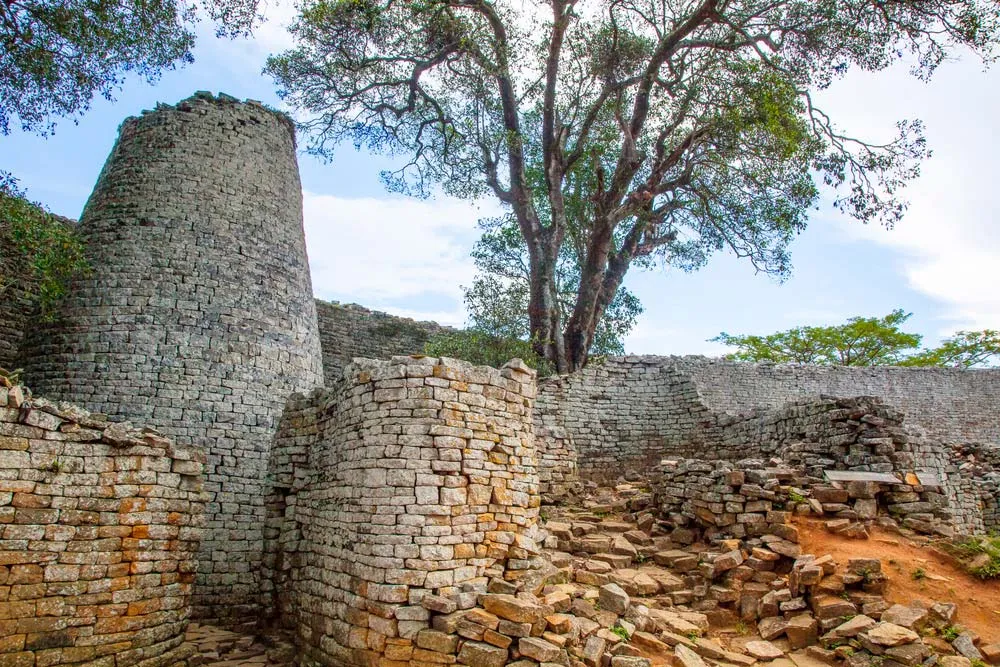
There are places that make history feel distant. Great Zimbabwe does the opposite. Stand before its immense granite walls and the past feels close: not as a vague legend, but as the work of people who planned, built, traded, governed and made a life here centuries ago.
Located in south-eastern Zimbabwe, about 30 kilometres from present-day Masvingo, Great Zimbabwe was a major centre of a Shona-speaking society between approximately the 11th and 15th centuries. Its name is commonly understood through the Shona words dzimba dzemabwe — houses of stone. The monument is not simply a collection of ruins. It is evidence of a sophisticated African society and a landmark of national and continental importance.
A city shaped by stone
The site developed over several centuries, with construction and occupation taking place broadly between about 1100 and 1450 CE. Its builders worked with the granite that defines the surrounding landscape. By selecting and fitting stone blocks carefully, they created substantial walls without relying on mortar.
The result is striking: long, curving enclosures that follow the contours of the land, carefully arranged passages, and walls whose scale and craftsmanship remain impressive today. The stonework was not the whole city. Archaeological evidence also points to homes and other structures made from daga — a building material formed from earth and clay — alongside the stone enclosures.
Three parts of a remarkable landscape
The monument is generally understood through three principal areas: the Hill Complex, the Great Enclosure and the Valley Ruins. Together they reveal a settlement that changed and expanded over time.
The Hill Complex
Set high among granite boulders, the Hill Complex contains stone-walled enclosures and evidence of long-term occupation. Its elevated position and layered structures make it one of the most distinctive parts of the site. Archaeologists have interpreted parts of the complex as having political and ritual significance, although the precise functions of individual spaces continue to be studied.
The Great Enclosure
South of the hill stands the Great Enclosure, the site’s most recognisable structure. Its sweeping outer wall forms an enormous oval, built from carefully laid granite blocks. Inside are further walls, spaces associated with domestic life and the famous Conical Tower. The purpose of every feature is not settled, and it is important to distinguish archaeological evidence from speculation.
The Valley Ruins
Across the valley are further residential enclosures and traces of everyday life. These remains remind us that Great Zimbabwe was more than a ceremonial monument or a ruler’s residence. It was a lived-in landscape, shaped by households, work, food production and social relationships.
UNESCO describes the World Heritage property as extending across almost 800 hectares. The monument was inscribed on the World Heritage List in 1986 and is recognised for its outstanding testimony to the Shona civilisation of the 11th to 15th centuries.
A centre connected to the wider world
Great Zimbabwe grew within a region rich in agricultural and mineral resources. Cattle were an important source of wealth, while farming, metalworking and craft production supported the community. Archaeological finds also point to trade connections extending beyond the immediate region.
Objects recovered from the wider site and associated trading networks include imported glass beads and ceramics, alongside evidence of local production in metals and pottery. These finds place Great Zimbabwe within wider exchange systems that connected the Zimbabwean plateau to the Indian Ocean world. The city was not isolated from the world around it; it was part of a network of movement, commerce and cultural contact.
Reclaiming the authorship of our history
Great Zimbabwe has also carried a difficult history beyond its walls. During the colonial period, some writers and visitors refused to accept that an African society had built such an accomplished stone city. They promoted unsupported explanations that attributed it to outsiders. Those claims reflected the racial assumptions of colonial rule, not the archaeological evidence.
Archaeological research established the African origins of the monument and its close association with the ancestors of the Shona people. That history matters. Great Zimbabwe is a reminder that African societies built complex centres of political, economic and cultural life long before colonial occupation.
The Zimbabwe Bird, carved from soapstone and found at the site, has become one of the country’s most recognisable national emblems. Its presence on the national flag connects the monument to modern Zimbabwe, while reminding us that heritage is not only about preserving objects. It is also about understanding the meanings communities attach to them.
Why Great Zimbabwe still matters
Today, Great Zimbabwe is a UNESCO World Heritage Site and a place of deep cultural significance. It attracts visitors, researchers and people returning to encounter a landmark they may have first learned about in school. For many Zimbabweans, it represents ingenuity, continuity and a history that cannot be reduced to the colonial record.
Its preservation requires care. Weather, vegetation, visitor pressure and the passage of time all place demands on the monument. Conservation is not simply about keeping old walls standing; it is about respecting the site, the knowledge associated with it and the communities whose histories are connected to the landscape.
Great Zimbabwe still speaks — through its stonework, its archaeology and the stories people continue to tell about it. Its message is not that the past was perfect or unchanging. It is that the people who came before us made, adapted and built a world of extraordinary achievement. That is a history worth knowing, protecting and passing on.
Further reading & sources
UNESCO World Heritage Centre, Great Zimbabwe National Monument — official inscription and description of the site.
National Museums and Monuments of Zimbabwe, Southern Region – Masvingo — site components and architectural information.
The Metropolitan Museum of Art, Great Zimbabwe — archaeological context, architecture and material culture.
Editorial note: Dates and interpretations are presented in line with the sources above. Some details of the site’s organisation and the function of individual structures remain subjects of archaeological research.